MEPCO Bill Taxes and Charges Explained in Simple Words
Understanding your electricity bill can be confusing when you see different taxes, adjustments, and surcharges added to the cost of your units. If you receive a MEPCO electricity bill, knowing what each amount means can help you understand why your total bill changes every month.
This guide explains MEPCO bill taxes and charges in simple words. You will learn about General Sales Tax (GST), Electricity Duty, Fuel Price Adjustment (FPA), Quarterly Tariff Adjustment (QTA), fixed charges, and other amounts that may appear on your bill.
What Are MEPCO Bill Taxes and Charges?
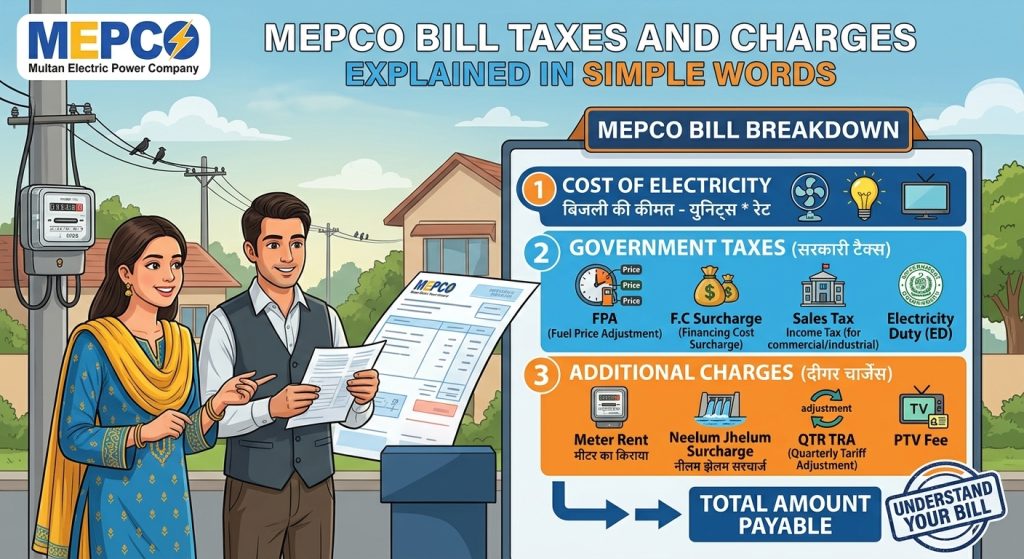
MEPCO bills include more than the cost of the electricity you use. Depending on your connection type and applicable government rules, your bill may also contain taxes, tariff adjustments, surcharges, previous dues, and late payment charges.
Some amounts are taxes collected for the government, while others are part of the electricity tariff or adjustments approved by the relevant authorities.
You can check your bill online through the MEPCO online bill website and compare its details with your previous bill.
1. General Sales Tax (GST)
General Sales Tax is a government tax applied to electricity bills according to the applicable tax rules.
In simple words: GST is an additional tax on eligible electricity charges. It increases the amount you must pay beyond the basic cost of your electricity.
The exact calculation depends on the applicable rules and the charges included in the taxable amount. The current rate and amount should be checked against your bill and official notifications.
2. Electricity Duty (ED)
Electricity Duty is a provincial duty that may appear as a separate item on your MEPCO bill.
In simple words: It is a government duty linked to electricity consumption and applicable charges. It is different from GST, even though both increase the payable amount.
The applicable rate can depend on the consumer category and current rules. If the amount seems incorrect, contact MEPCO and ask how it was calculated.
3. Fuel Price Adjustment (FPA)
Fuel Price Adjustment, sometimes called Fuel Charges Adjustment, reflects changes in the fuel cost used to generate electricity.
Fuel prices and the electricity generation mix can change over time. The adjustment helps account for differences between the actual fuel cost and the reference cost included in the tariff.
In simple words: FPA adjusts your bill when the approved fuel cost changes.
It may increase or decrease the amount payable, depending on the applicable adjustment. The amount shown can relate to a previous billing period rather than only the current month’s consumption.
4. Quarterly Tariff Adjustment (QTA)
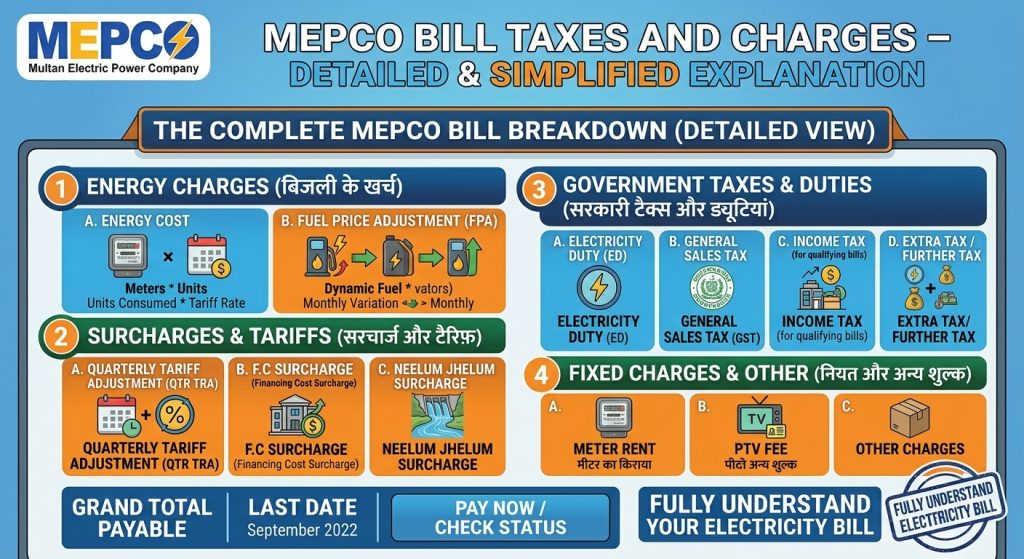
Quarterly Tariff Adjustment is used to account for certain changes in electricity-sector costs over a three-month period.
In simple words: QTA is a periodic adjustment that may be added to or deducted from your electricity bill under the applicable tariff decision.
The amount and period covered depend on the relevant notification. It is not necessarily a tax, so it should not be confused with GST or Electricity Duty.
5. Fixed Charges
Fixed charges are amounts applied according to the applicable tariff and connection category. For eligible connections, they may depend on the sanctioned load or other tariff conditions.
In simple words: A fixed charge is not calculated only from the number of units you consume. It can apply according to your connection’s tariff rules.
If your bill has increased despite using fewer units, check whether fixed charges or a revised tariff category contributed to the difference.
6. Financing or Debt Servicing Surcharge
Your bill may include a financing cost or debt servicing surcharge under the applicable government and tariff rules.
In simple words: This is a surcharge associated with costs in the power sector. It is separate from the basic cost of your electricity units.
The applicable rate and any exemptions depend on the current rules and your consumer category. Do not assume the same amount applies to every connection.
7. Income Tax and Other Applicable Taxes
Some consumers may see income tax, withholding tax, or other tax-related entries on their bills.
Whether these amounts apply can depend on factors such as the type of connection, bill amount, tax status, and current government rules.
Commercial and industrial connections may also be subject to tax requirements that differ from those for domestic consumers.
Important: Do not assume that every MEPCO customer must pay every type of tax. Check the specific entry on your bill and confirm its applicability with MEPCO or the relevant tax authority.
8. Arrears and Previous Dues
Arrears are unpaid amounts carried forward from earlier bills. They can increase the total payable amount even when your current electricity consumption has not changed much.
For example, if part of a previous bill remains unpaid, that balance may appear in the current bill.
If you have already paid the previous amount, compare your payment receipt with the bill. If the payment is missing, contact MEPCO with your reference number and proof of payment.
9. Late Payment Surcharge
A Late Payment Surcharge (LPS) may apply when a bill is not paid within the permitted time, according to the applicable rules.
In simple words: It is an additional amount for late payment.
Check both the amount payable by the due date and the amount payable after the due date. Paying on time can help you avoid an additional charge.
Why Does Your MEPCO Bill Increase Every Month?
Your electricity bill can change for several reasons, even if the difference in units is small. Common reasons include:
- Higher electricity consumption or a change in applicable tariff slabs.
- Fixed charges based on your connection’s tariff.
- An increase in FPA or QTA.
- Taxes and surcharges calculated under current rules.
- Previous unpaid dues or an installment.
- A late payment surcharge.
- An estimated meter reading or an incorrect billing entry.
To understand an increase, compare the units consumed, meter readings, tariff details, adjustments, taxes, and previous dues on your current and previous bills.
How to Check MEPCO Bill Taxes and Charges
Follow these simple steps to review your bill:
- Open the MEPCO online bill website.
- Enter the required reference number or customer information.
- View your latest available bill.
- Check the units consumed and the cost of electricity.
- Review each tax, surcharge, and adjustment separately.
- Compare the current bill with your previous bill.
- Contact MEPCO if an amount is unclear or appears incorrect.
For official tariff and consumer information, visit the MEPCO website or consult the NEPRA website.
What Should You Do If a Tax or Charge Looks Incorrect?
First, identify the exact line on your bill that you do not understand. Check the amount, billing period, meter reading, tariff category, and previous payment record.
Keep a copy of the bill and any relevant payment receipts. Then contact your local MEPCO subdivision or customer service centre and request an explanation or correction.
If the issue remains unresolved, you can review the complaint options available through the NEPRA website.
Never assume that a charge is incorrect simply because it is new. Some adjustments apply periodically under official notifications, while genuine billing errors should be investigated.
Frequently Asked Questions
Are all MEPCO bill charges taxes?
No. GST and Electricity Duty are examples of taxes or duties. FPA and QTA are tariff adjustments, fixed charges are tariff-based amounts, and late payment surcharge is related to overdue payment.
Why is my MEPCO bill high when I used fewer units?
Your total may include fixed charges, tariff changes, FPA, QTA, taxes, arrears, or other applicable amounts. Compare the detailed entries rather than looking only at the units consumed.
Does FPA increase every month?
No. FPA depends on the approved adjustment for the relevant period. It can vary and may increase or reduce the payable amount.
How can I confirm the current tax rate?
Check the latest applicable government notification and official information from MEPCO or the relevant authority. Tax rates and billing rules can change, so older online guides may not reflect the current position.
Can I complain about an incorrect MEPCO bill?
Yes. Contact MEPCO with your reference number, bill copy, and supporting evidence. If the issue is not resolved, consult the official complaint options available through NEPRA.
Conclusion
Understanding MEPCO bill taxes and charges makes it easier to identify what you are paying for each month. GST and Electricity Duty are different from adjustments such as FPA and QTA, while fixed charges, arrears, and late payment surcharges have their own purposes.
Always check the detailed bill, compare it with your previous statement, and confirm unfamiliar amounts through official sources. This simple habit can help you understand unexpected increases and report genuine billing errors.